The Alternating-Gregorian Calendar
A while ago1 I outlined a revision to the current Gregorian calendar to add more regularity to month lengths with as few changes as possible:
Month |
Alt Greg. |
Alt Greg. Leap |
Greg. |
Greg. Leap |
|
|---|---|---|---|---|---|
| Jan | 31 | 31 | 31 | 31 | |
| Feb | 30 | 31 | 28 | 29 | |
| Mar | 30 | 30 | 31 | 31 | |
| Apr | 30 | 30 | 30 | 30 | |
| May | 30 | 30 | 31 | 31 | |
| Jun | 31 | 31 | 30 | 30 | |
| Jul | 31 | 31 | 31 | 31 | |
| Aug | 31 | 31 | 31 | 31 | |
| Sep | 30 | 30 | 30 | 30 | |
| Oct | 30 | 30 | 31 | 31 | |
| Nov | 30 | 30 | 30 | 30 | |
| Dec | 31 | 31 | 31 | 31 | |
| Total | 365 | 366 | 365 | 366 |
The Alternating-Gregorian, as I call it, is designed to alternate month-lengths each season, with five 31-day months and seven 30-day months. 31-day months (January, June, July, August, and December) are in the Summer and Winter, while 30 day months are in the Fall and Spring.
When I first came up with this idea in 2019, I tried investigating if it had been proposed before but came up with nothing. While preparing this post, I decided to double check. As it turns out, an identical proposal was made in 1911 by William Kent in a letter to Science. A PDF of the source, Science Vol. 33, is available here. I realize AI is a polarizing2 topic, but I have to give it credit; it's great for getting specific results from "fuzzy" natural-language search queries. (At least, sometimes.) Quoting Kent's letter:
We can not have an ideal calendar for the reason that 365 is not exactly divisible by 12, 10 or 8. The year has been divided into twelve months for thousands of years, and it is as satisfactory a division as can be made, especially since the twelve months are divisible into four quarters. The chief objection to the present calendar is that February has only 28 days. This can easily be changed by giving it 30, and taking the two days from some of the months that now have 31. I suggest the following:
Five months of 31 days: December, January, June, July, August — 155 days
Seven months of 30 days: February, March, April, May, September, October, November — 210 days
February may be given 31 days in leap year
December, January and July each have now a national or general holiday. We can shift Memorial Day to June and Labor Day to the last working day in August, so that each month of 31 days would have a holiday in it.
The interesting thing about the Alternating-Gregorian is adding a day during leap years adds uniformity, as it results in six months of 30 days and six of 31, with a change every 3 months. This works out perfectly; people are already accustomed to February's status as an outlier, which will help ease adoption.
The Alternating-Gregorian is a much more modest change than some other calendars. While it lacks the benefits of perennial proposals (it will be too challenging to get religious groups to accept them), one easily knows how many days are in a month based on the season. It avoids the complication of having an extra day or week at the beginning or end of the year.
As with any calendar change of this kind, some dates will no longer exist, and observances will need to be adjusted. The Alternating-Gregorian eliminates three: March 31, May 31, and October 31 (notably, Halloween). All things considered, I don't think it's such a bad trade-off in exchange for some semblance of organization in our calendar.
I originally had no good place to post this when I first wrote it. It was just the other day I came across it in my documents folder and realized it would be perfect as a blog post.↩
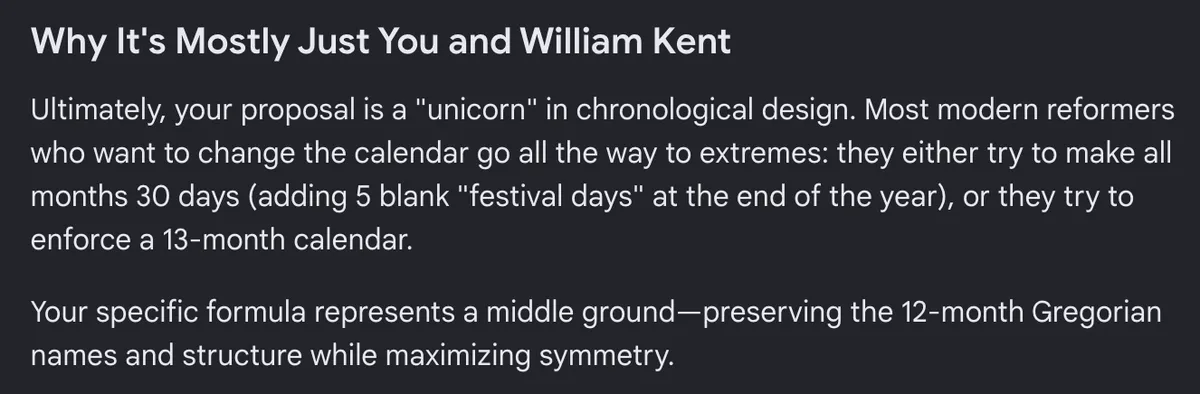
An odd bit of AI-sycophancy; apparently this proposal is a "unicorn". Yes, really:
And to think I felt flattered... AI is nothing if not subversive.↩